

Fast, Furious, and Wrong: Why Speed Only Counts When the Number Is Right
Every formulation group is under the same pressure: compress the timeline of screening and get to a lead candidate before the next stage. Throughput has quietly become the headline metric for analytical method selection, and for good reason.
But there is a failure mode people may overlook until it is too late: measuring quickly in the wrong direction. An instrument that returns a biased number quickly has not saved you anything. The cost just moves downstream, where it is far more expensive to fix.
Speed is real, and it matters
A modern excipient and buffer screen can run 96 conditions before anyone commits to a lead (Xin et al., 2024).
- Scarce material means fewer shots at the question
- Iterative work punishes every wasted cycle
- Formulation windows that once held a full Design of Experiments (DOE)
Viscosity is one of the harder measurements in this phase, and one of the most necessary. Speed and low sample volume are what make it possible to run at all.
Fast results but where it goes wrong
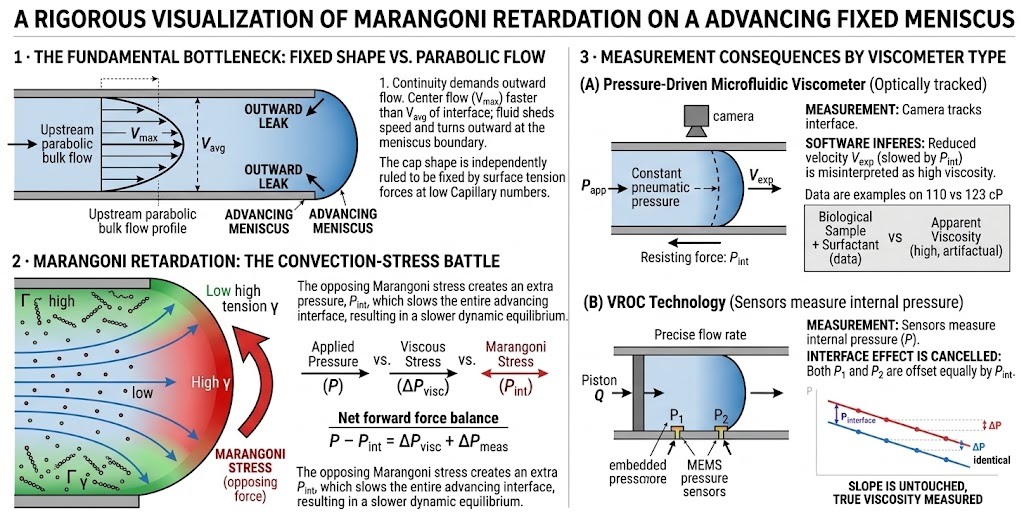
Some instruments marketed as microfluidic viscometers are pressure-driven capillary devices. The sample still meets an air interface, and surfactant or protein adsorption at that interface creates a surface tension gradient that opposes flow. The measured pressure drop includes that resistance.
At low flow rates and in surfactant-containing formulations, which describes most high-concentration mAb work, the reported viscosity comes out high, and the error scales with how long the protein has had to reach the interface. This is Marangoni retardation, and pressure-driven designs cannot eliminate it.
-
Marangoni Effect where pressure-driven designs cannot eliminate while VROC technology can
- Shear rate is unknown or unreported. High concentration mAb solutions shear thin. A viscosity value with no stated shear rate cannot be compared to anything, including the next plate.
- Not first principle. Correlated or comparative outputs are fine for pass/fail on a line. They are not what you want anchoring a formulation decision that will be defended in a filing.
What ignoring a larger % error can do long term
Systematic bias does not just shift each result slightly. It changes which result wins. Teams often treat 10 percent error as acceptable at early stage. Consider what that assumption actually costs, and note that 10 percent is the optimistic case.
Consider a screen where the top three excipient conditions land at 18.2, 19.4, and 20.1 cP. Those are meaningfully different formulations to a fill-finish team and to a patient with a 27G needle. Now apply a 6 percent temperature-driven bias that does not fall evenly across the plate. The ranking inverts. Nothing in the data flags it. The report looks clean, the throughput number looks excellent, and the wrong candidate advances.
You will find out. The only question is whether you find out during the screen or during tech transfer, when the material is scaled, the syringe is chosen, and the change control cost has gone up by two orders of magnitude.
Accuracy with speed is the actual requirement
Speed and accuracy are not a tradeoff. What a formulation team should demand from a viscosity method:
- First Principle not a correlated or instrument-specific index
- A defined, user-selected shear rate so non-Newtonian behavior is characterized
- Temperature control at the sample
- Microliter sample volumes with recovery or retrieval so precious material survives the screen and can be recovered or retested
- Results that transfer between operators, instruments, and sites without a correction factor
- Throughput and automation compatibility that does not cost you any of the above
TL;DR
Defensible results per hour is the metric that matters, not samples per hour. A formulation that fails at injectability failed during the screen. It just took months to find out.
Run fast. Make sure the number you're running toward is the right one.
Sources:
- Xin L, Lan L, Mellal M, McChesney N, Vaughan R, Berdugo C, Li Y, Zhang J. "Leveraging high-throughput analytics and automation to rapidly develop high-concentration mAb formulations: integrated excipient compatibility and viscosity screening." Antibody Therapeutics. 2024;7(4):335-350. doi:10.1093/abt/tbae028. PMCID: PMC11646310.