
How Do I Find the Right Viscometer?
A practical guide to choosing the instrument that actually fits your sample, your workflow, and your budget.
Looking for a viscometer can feel overwhelming, but it doesn't have to be. Two labs measuring the same property can land on completely different "right" answers. The hard part isn't the science. It's matching the instrument to your sample, your volume, and your workflow, and whether you want accurate numbers or just a number. (Psst… if accuracy weren't the point, why measure at all?)
The short answer
The right viscometer is the one that covers your viscosity range and shear-rate needs at the sample volume you can actually spare, with the throughput your workflow requires. If your samples are precious, limited, or non-Newtonian (proteins, polymers, complex formulations), a small-sample microfluidic viscometer is almost always the better fit than a conventional rotational or capillary instrument.
If you only read one thing: start with sample volume and shear rate. Those two questions eliminate most of the field on their own.
The five questions that actually decide:
1. How much sample do I have to give up per measurement?
Conventional rotational viscometers and falling-ball instruments can demand milliliters of sample. If you're working with a high-value protein therapeutic, a scarce biological sample, or an early-stage formulation where every microliter counts, that's a non-starter.
Microfluidic instruments built on a flow-through chip measure with microliters, not milliliters. That single difference reshapes what's possible. Test candidates earlier, repeat more often, and stop treating each measurement as a sacrifice, all without giving up accuracy. Smaller sample, same true viscosity numbers.
2. What's my viscosity range, and does my sample shear-thin?
Water sits near 1 mPa·s. Concentrated antibody formulations, polymer melts, and adhesives can climb into the thousands. Make sure the instrument's dynamic range comfortably covers your samples.
Then comes the question, does my sample shear-thin? Proteins at high concentration, polymer solutions, coatings, and many complex fluids do. If yours does, a single-point measurement is misleading — you need an instrument with a controlled, variable shear rate so you can see how viscosity changes across conditions. If your sample is genuinely Newtonian and simple, you can prioritize speed and ease over shear-rate flexibility.
3. How many samples am I running, and how often?
A research group characterizing a handful of candidates a week has very different needs from screening operation pushing dozens of samples a day.
- Low to moderate volume, hands-on: a portable or semi-automated instrument is plenty.
- High throughput / screening: you want accurate automation — well-plate handling, automated cleaning, unattended overnight runs. Manual instruments become a bottleneck fast. If you just get numbers, however, what is the point? Get ahead by getting accurate measurements from the get-go so you don't have to revisit or go back. You can also prevent incorrectly choosing or taking out candidates early on.
4. Who will run it?
A benchtop R&D instrument and a field-portable unit are different tools. Is this going in a controlled lab, on a production floor, or inside a glovebox? Will a trained scientist run it, or a field operator who needs a result in under a minute with minimal training?
5. Does it require specific standards, temperature, or specialty requirements?
- Regulatory/standards: Do you need to meet specific standards? 21CFR Part 11 software required?
- Temperature control: Specific temperatures in mind? You actually should. Viscosity is strongly temperature-dependent. You should conduct measurements at controlled or multiple temperatures (or sweeps).
- Specialty measurements: Do you need intrinsic viscosity, extensional viscosity, or sample stability and aggregation insight?
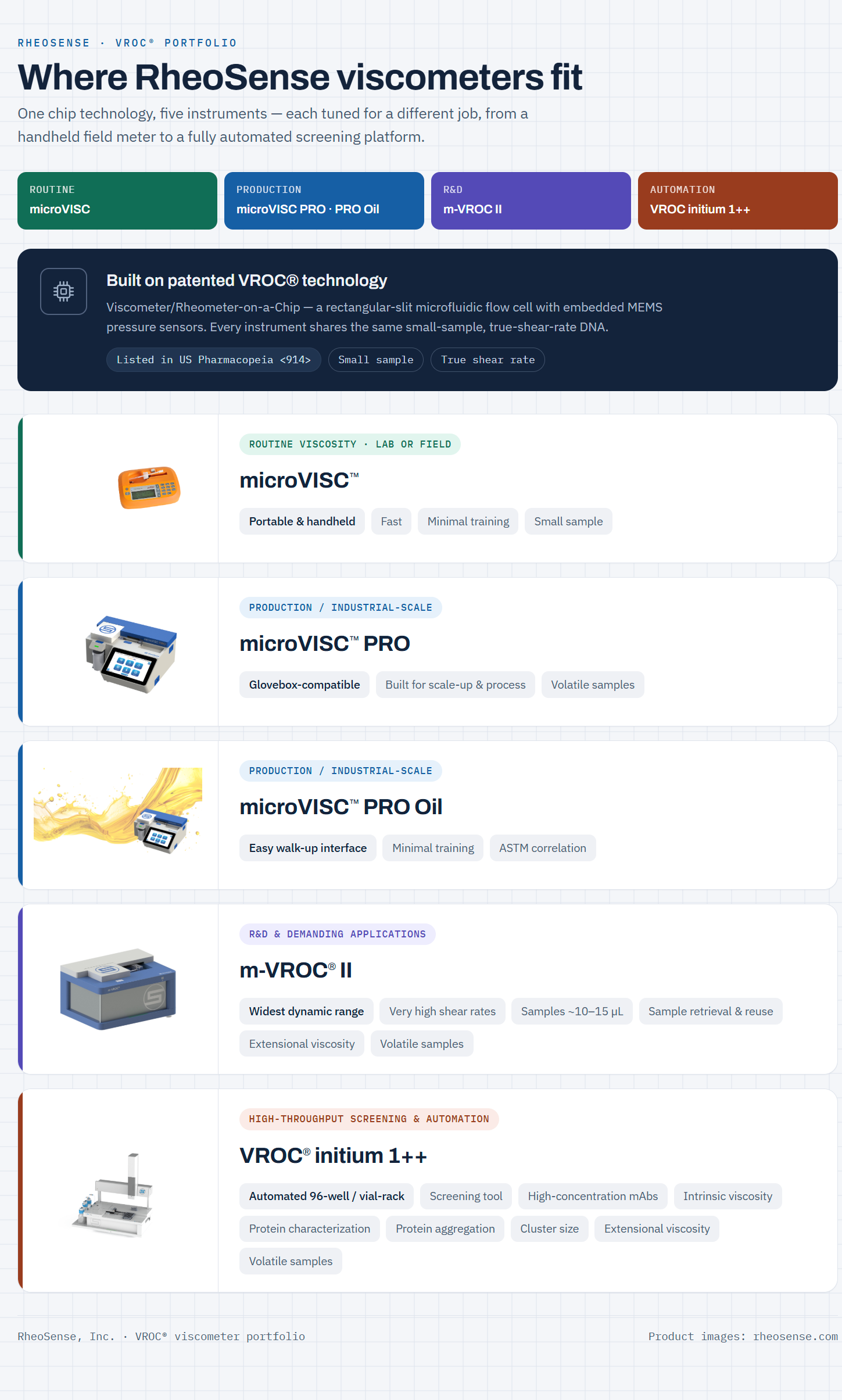
Where RheoSense viscometers fit
Every RheoSense viscometer is built on patented VROC® (Viscometer/Rheometer-on-a-Chip) technology. Listed in US Pharmacopeia chapter 914, it is also called a rectangular-slit microfluidic flow cell with embedded MEMS pressure sensors. RheoSense viscometers all share the small-sample, true-shear-rate DNA, but they're tuned for different jobs:
| Viscometer | Best for | Standout strength |
|---|---|---|
| microVISC™ | Routine viscosity, lab or field | Portable, fast, minimal training, small sample |
| microVISC™ PRO | Production / industrial-scale, environments | Glovebox-compatible, built for scale-up and process, perfect for volatile samples |
| microVISC™ PRO Oil | Production / industrial-scale, environments | Minimal training with easy walk up interface, ASTM Correlation |
| m-VROC® II | R&D and demanding applications | Widest dynamic range, very high shear rates, sample volumes as low as ~10-15 µL, sample retrieval and reuse, perfect for volatile samples, extensional viscosity |
| VROC® initium 1++ | High-throughput screening & automation | Automated 96-well-plate / vial-rack testing, screening tool, perfect for high concentration mAbs, intrinsic viscosity, protein characterization, extensional viscosity, protein aggregation, cluster size, perfect for volatile samples |
Frequently asked questions
What's the difference between a viscometer and a rheometer? A viscometer measures viscosity, a fluid's resistance to flow. A rheometer characterizes flow and deformation behavior. VROC® technology blends both worlds by measuring true viscosity across a controlled range of shear rates on a single platform.
Do I need controlled shear rate? If your sample is non-Newtonian, most proteins at high concentration, polymers, coatings, adhesives, yes. A single fixed-shear reading won't tell the whole story. Some proteins behave as Newtonian fluids at first, only revealing non-Newtonian behavior once the shear rate climbs past a critical point.
What's the smallest sample I can measure? With VROC® based viscometers, viscosity can be measured on the order of ~15 microliters depending on the instrument and chip configuration, versus the milliliters many conventional instruments require.
Can one instrument handle both R&D and high-throughput QC? Sometimes, but it's usually better to match the instrument to the dominant workflow. R&D leans toward m-VROC® II; high-throughput screening leans toward VROC® initium 1++.
The bottom line
Start with your sample volume and your shear-rate needs, then layer on throughput, environment, and any standards or specialty measurements. Answer those honestly and the field narrows on its own.
Not sure which model fits your samples? Our team can help you match an instrument to your application! Reach out to talk through your samples.
TL;DR